
The Krav Maga Approach To Violence
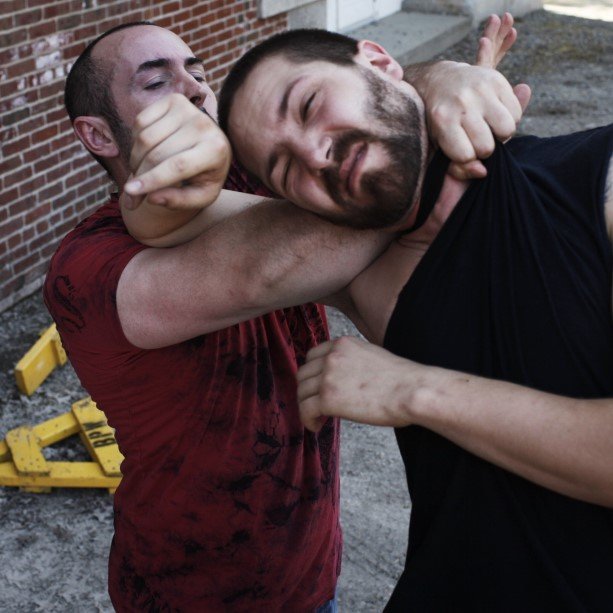 Krav Maga, meaning "Contact Combat" in Hebrew was originally a distinct system of self-defense and hand-to-hand fighting developed by
Imi Lichtenfeld (26th May 1910 - 9th January 1998).
The goal of his system was to train, a soldier with no previous martial arts or self-defense training, to be able to defend themselves, against a variety of armed and unarmed attacks in
the shortest possible time. He was developing his system against the backdrop of Israeli Independence, as the underground resistance movements (e.g. the Haganah - meaning "Defense" in
Hebrew) were about to be amalgamated into the fledgling IDF (Israeli Defense Forces). The fact that the Jewish population of Palestine, would be attacked the moment they declared themselves
an Independent Jewish State, not just be their domestic Arab neighbors, but by the armies of the Arab countries that surrounded their territory e.g. Lebanon, Egypt, Syria and Jordan,
would mean that Israeli Soldiers would not have much time to train before they had to put their fighting skills to the test in real-life encounters. These countries had already decided
how they would divide up the land between themselves e.g., Jordan taking control of the western parts of the country, Lebanon the North, and Egypt the South. These countries, along with Iraq,
had already stated that their goal would be to push any "Jewish State" into the sea i.e., the Mediteranean Sea.
Krav Maga, meaning "Contact Combat" in Hebrew was originally a distinct system of self-defense and hand-to-hand fighting developed by
Imi Lichtenfeld (26th May 1910 - 9th January 1998).
The goal of his system was to train, a soldier with no previous martial arts or self-defense training, to be able to defend themselves, against a variety of armed and unarmed attacks in
the shortest possible time. He was developing his system against the backdrop of Israeli Independence, as the underground resistance movements (e.g. the Haganah - meaning "Defense" in
Hebrew) were about to be amalgamated into the fledgling IDF (Israeli Defense Forces). The fact that the Jewish population of Palestine, would be attacked the moment they declared themselves
an Independent Jewish State, not just be their domestic Arab neighbors, but by the armies of the Arab countries that surrounded their territory e.g. Lebanon, Egypt, Syria and Jordan,
would mean that Israeli Soldiers would not have much time to train before they had to put their fighting skills to the test in real-life encounters. These countries had already decided
how they would divide up the land between themselves e.g., Jordan taking control of the western parts of the country, Lebanon the North, and Egypt the South. These countries, along with Iraq,
had already stated that their goal would be to push any "Jewish State" into the sea i.e., the Mediteranean Sea.
To do this, Lichtenfeld designed his system around the body's natural reflexive responses when attacked e.g. people naturally flinch when they catch movements coming towards them, a person's hands will automatically come up to pull an attacker's hands or arm(s) away if they are being choked or strangled, the hips will be pulled back, and the arms will go forward if an upwards attack to the groin/stomach area is detected etc. Rather than trying to change the way a person naturally responds and try to replace these natural reactions with "trained" movements, Lichtenfeld built upon them, to create a system of self-defense that was based on the way a person will respond when attacked, rather than how they may like to think they'll respond. He also looked to re-use techniques, so that a defense against a rear strangle, was similar to a defense against a knife threat to the front of the throat, when the attacker is standing behind their target e.g. in a hostage type situation. His original system consisted of something around 28 techniques, and was designed to be used by an infantry soldier carrying a pack on his back - this is why his original system contained only forward movement (to have sideways movement may have compromised the balance of the soldier).
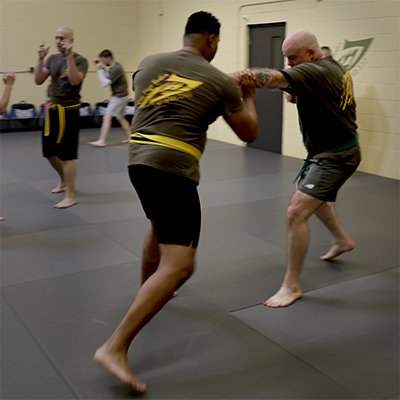 Imi also drew on his experiences as a young man, fighting against Fascist street gangs, in his native Slovakia. In these situations he had both witnessed the way untrained people responded to
various attacks, and come to understand what real-life violence actually looked like e.g. multiple assailants who were probably armed. From this he understood that it was not possible to spend
an extended period of time dealing with one attacker; each one needed to be dealt with and dispatched as quickly as possible, which meant using strikes to soft and vulnerable targets such as
the eyes and groin.
Imi also drew on his experiences as a young man, fighting against Fascist street gangs, in his native Slovakia. In these situations he had both witnessed the way untrained people responded to
various attacks, and come to understand what real-life violence actually looked like e.g. multiple assailants who were probably armed. From this he understood that it was not possible to spend
an extended period of time dealing with one attacker; each one needed to be dealt with and dispatched as quickly as possible, which meant using strikes to soft and vulnerable targets such as
the eyes and groin.
Imi left the IDF in 1964 and started developing his Krav Maga system for civilians, later establishing the non-profit IKMA (Israeli Krav Maga Association) in 1988. Of course Krav Maga didn't stop evolving, and the IDF (Israeli Defense Forces) didn't stop looking at other systems of close combat, and other instructor's approaches to self-defense and fighting. One of the most influential instructors to affect the IDF's approach to hand-to-hand fighting was Doctor Dennis Hanover (founder of DSJJ - Dennis Survival Ju-Jitsu - which is often referred to as Hisardut, meaning "Survival" in Hebrew). Dennis Hanover's background was in the traditional martial arts and his approach emphasized the need for dynamic and full contact training. He also demonstrated how traditional systems such as Judo and Karate could be adapted for military use.
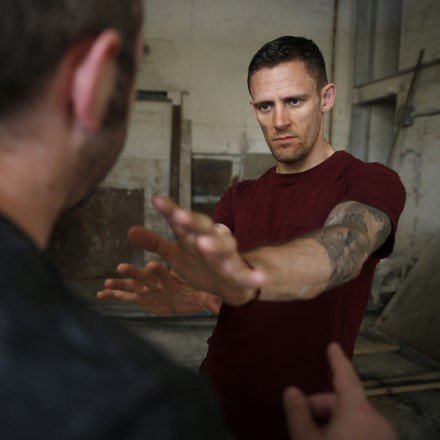 Krav Maga continued to develop in the civilian sector, with many of Imi's top belts going on to form their own associations and develop and evolve his approach to self-defense and close combat
and/or mix it with their own backgrounds in other martial arts and systems. The way in which Krav Maga has evolved and developed into a number of distinct systems means that "Krav Maga" is more
of a generic term that refers to a number of systems which share a common approach and methodology rather than to a distinct system of self-defense. The IDF itself uses Krav Maga in this manner,
as an umbrella term, for what its hand-to-hand combat instructors teach.
Krav Maga continued to develop in the civilian sector, with many of Imi's top belts going on to form their own associations and develop and evolve his approach to self-defense and close combat
and/or mix it with their own backgrounds in other martial arts and systems. The way in which Krav Maga has evolved and developed into a number of distinct systems means that "Krav Maga" is more
of a generic term that refers to a number of systems which share a common approach and methodology rather than to a distinct system of self-defense. The IDF itself uses Krav Maga in this manner,
as an umbrella term, for what its hand-to-hand combat instructors teach.
The Krav Maga Yashir system stays true to the ideas and concepts that Imi Lichtenfeld and those who worked with him developed but has modernized and evolved as was the goal to deal with real-life violence, which in turn has changed and evolved over time. The system also uses more modern training methods that have been developed as part of MMA (Mixed Martial Arts), and other combat sports. This doesn’t mean that Krav Maga techniques have come from these systems, but rather that the training methods which see striking, merge into grappling, into ground etc., have been adopted into the practice of Krav Maga etc. This reflects the original goal of Krav Maga, which is to learn and take from everything/everywhere, and adopt according to the concepts and principles laid down. To read more about the common principles and concepts that Krav Maga systems are founded upon,and those which make the Krav Maga Yashir system unique please click here.
If you would like to learn more about Krav Maga Yashir’s Head Instructor, Gershon Ben Keren and how he has added a personal-safety/self-protection component to the Krav Maga Yashir program/syllabus, you can click here. As a Criminologist who has been working in the security industry since 1990, he understands the importance of being able to both predict and avoid violence, rather that solely training to deal with it from a physical perspective.