
De-Escalation
 Most acts of violence are the result of everyday social interactions that have taken a wrong turn e.g., a misunderstanding over a parking spot, a place in a line/queue, or the accidental
spilling of a drink over somebody etc. These are incidents where an individual can respond in an overly emotional fashion, putting all rational aside. Fortunately, these types of situation
can often be de-escalated if the correct tactics and processes are used. Effective
de-escalation training is a key component on effective
personal-safety training.
Most acts of violence are the result of everyday social interactions that have taken a wrong turn e.g., a misunderstanding over a parking spot, a place in a line/queue, or the accidental
spilling of a drink over somebody etc. These are incidents where an individual can respond in an overly emotional fashion, putting all rational aside. Fortunately, these types of situation
can often be de-escalated if the correct tactics and processes are used. Effective
de-escalation training is a key component on effective
personal-safety training.
De-escalation is a process that seeks to prevent conflicts from escalating into violence by using words, tone, body language, and situational management to reduce tension. Our de-escalation approach emphasizes that it is not simply about talking someone down but about understanding the psychology of aggression and the dynamics of confrontation. Violence rarely happens without warning. Even spontaneous acts of aggression are preceded by emotional triggers, physiological arousal, and behavioral cues that can be observed and influenced. The ability to de-escalate depends on recognizing these signals and responding in ways that do not fuel hostility. Rather than relying on rigid scripts, effective de-escalation involves adapting communication to the individual, the environment, and the context of the encounter.
One of the central insights of our approach is that people escalate toward violence for different reasons. Some aggressors are instrumental, using threats or intimidation as a means to an end, such as gaining compliance, money, or status. Others are affective, acting out of anger, frustration, or perceived disrespect. De-escalation strategies differ depending on which type of aggression is present. Instrumental aggression may be reduced by showing the aggressor that continuing would not achieve their goals or by creating exit opportunities that allow them to withdraw without losing face. Affective aggression often requires calming the emotional state of the individual through empathy, non-provocative body language, and careful verbal choices.
 Another important point is the role of status, pride, and “face.” Many confrontations escalate because individuals feel humiliated, ignored, or disrespected. We highlight the importance of
preserving the other person’s dignity during a confrontation. This does not mean surrendering to unreasonable demands but rather finding ways to communicate that reduce the perceived need to
fight for respect. Something as simple as tone of voice, avoiding sarcasm, or acknowledging the person’s perspective can reduce their need to prove themselves through aggression. Recognizing
that escalation often stems from perceived social threats helps explain why logical arguments or demands rarely calm someone down. De-escalation is less about facts and more about feelings.
Another important point is the role of status, pride, and “face.” Many confrontations escalate because individuals feel humiliated, ignored, or disrespected. We highlight the importance of
preserving the other person’s dignity during a confrontation. This does not mean surrendering to unreasonable demands but rather finding ways to communicate that reduce the perceived need to
fight for respect. Something as simple as tone of voice, avoiding sarcasm, or acknowledging the person’s perspective can reduce their need to prove themselves through aggression. Recognizing
that escalation often stems from perceived social threats helps explain why logical arguments or demands rarely calm someone down. De-escalation is less about facts and more about feelings.
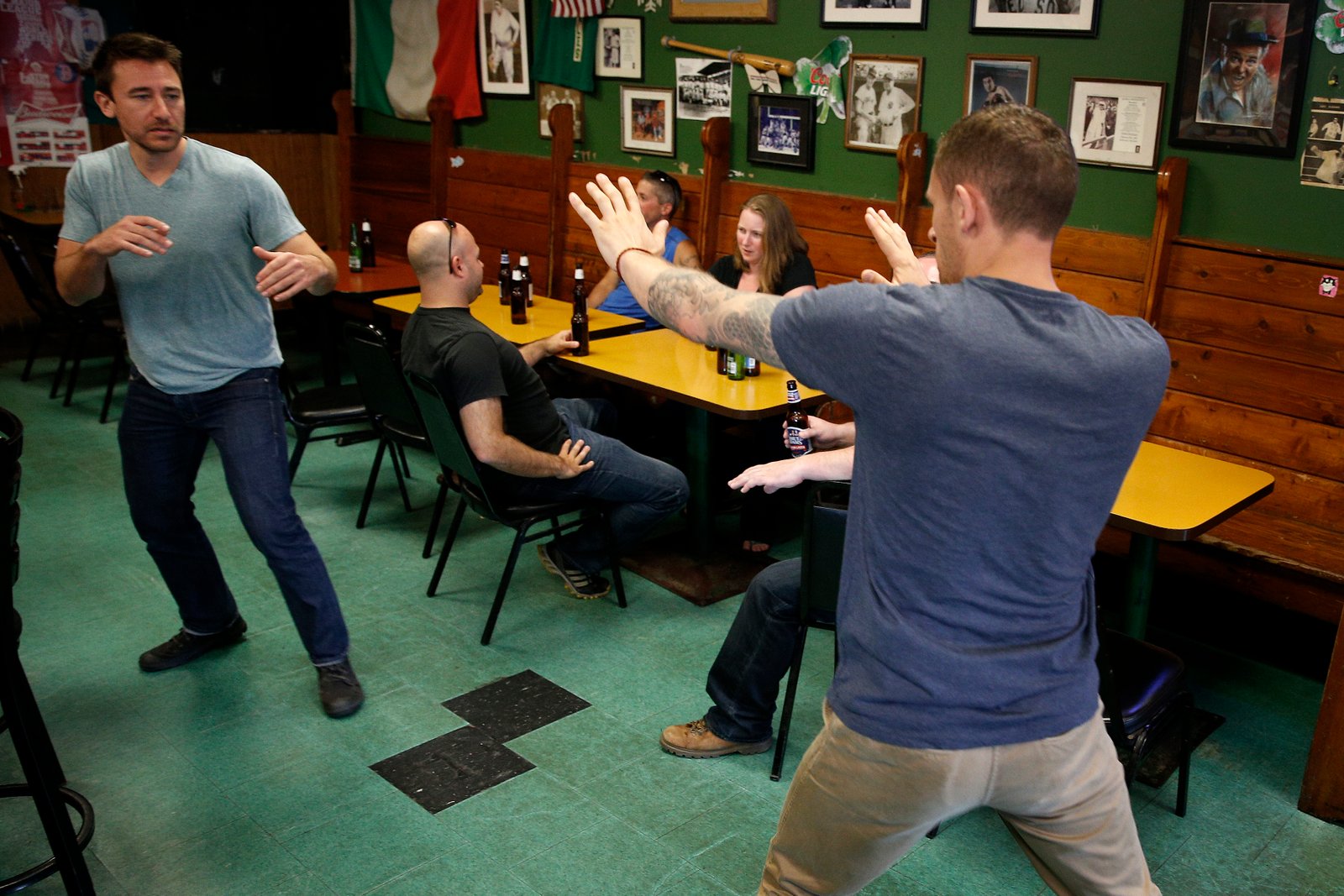
Physical positioning also plays a role. Standing too close, squaring off directly, or gesturing in aggressive ways can heighten the sense of threat and drive a person toward violence. A more angled stance, open hand gestures, and keeping a safe but respectful distance signal non-hostility while still allowing room for quick defensive action if needed. We often stress the importance of balancing safety with communication. De-escalation is not passive; it is proactive management of distance, angles, and environment while working verbally to lower tension. Creating or identifying escape routes, positioning yourself near exits, and scanning for environmental hazards are practical components that support the verbal side of de-escalation.
Listening is another critical part of the process. People often escalate because they do not feel heard or understood. Active listening—nodding, using reflective statements, and demonstrating genuine attention—can help reduce this frustration. This is not about agreeing with the aggressor but about showing that their words are acknowledged. Interrupting, dismissing, or lecturing tends to amplify hostility, while allowing someone to vent in a controlled manner can deflate the emotional charge behind their aggression. However, boundaries must also be set, since letting someone escalate unchecked can embolden them. The skill lies in giving space without ceding control.
We also emphasize the role of self-regulation. De-escalation is not only about managing the aggressor’s emotions but also one’s own. When confronted with anger, fear responses such as fight, flight, or freeze may take over. These can lead to defensive hostility, retreat that communicates weakness, or stunned silence that invites further escalation. Training to stay calm under pressure, to keep breathing steady, and to remain task-focused is as much a part of de-escalation as verbal strategies. If the practitioner loses control of their own emotions, they cannot hope to manage someone else’s.
 Another challenge is recognizing when de-escalation is failing and when disengagement or defensive action becomes necessary. Not every conflict can be talked down, and clinging to de-escalation in the
face of imminent violence can be dangerous. Our approach underscores the need for constant threat assessment, recognizing cues such as clenched fists, target glances, or sudden shifts in posture that
indicate a move toward physical aggression. In these moments, de-escalation may shift into creating time and space for disengagement or preparing to defend against attack. Effective self-defense training,
therefore, must integrate de-escalation with physical skills, so that one naturally flows into the other depending on circumstances.
Another challenge is recognizing when de-escalation is failing and when disengagement or defensive action becomes necessary. Not every conflict can be talked down, and clinging to de-escalation in the
face of imminent violence can be dangerous. Our approach underscores the need for constant threat assessment, recognizing cues such as clenched fists, target glances, or sudden shifts in posture that
indicate a move toward physical aggression. In these moments, de-escalation may shift into creating time and space for disengagement or preparing to defend against attack. Effective self-defense training,
therefore, must integrate de-escalation with physical skills, so that one naturally flows into the other depending on circumstances.
The broader goal of de-escalation, as framed in our de-escalation approach, is not only to avoid physical violence but also to reduce harm in the long term. Every violent incident can have legal, psychological, and social consequences for all involved. By preventing escalation, individuals protect themselves not just physically but also emotionally and legally. In professional contexts such as law enforcement, healthcare, or education, the ability to de-escalate can mean the difference between a safe outcome and an incident that spirals into lawsuits, trauma, or tragedy.
Ultimately, de-escalation is a skill set that requires awareness, adaptability, and practice. It combines an understanding of human aggression with practical communication and positioning strategies. Gershon Ben Keren’s contributions highlight the fact that violence prevention is not about winning arguments or dominating others but about managing encounters in ways that allow both sides to disengage safely. It is about creating pathways out of conflict rather than pushing people deeper into it. In this way, de-escalation represents one of the most essential, humane, and realistic components of modern self-defense.