
Krav Maga & The Israeli Martial Arts
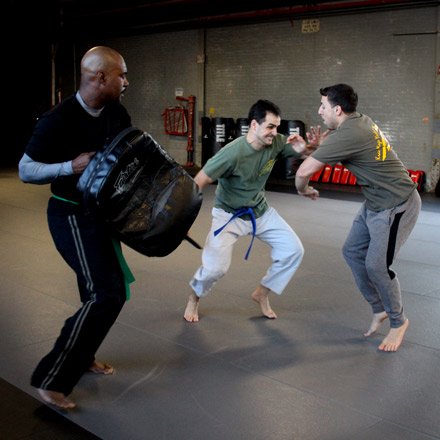 The story of Krav Maga, the martial art most closely associated with Israel, is inseparable from the country’s turbulent history, the formation of its military, and the need for
pragmatic systems of self-defense. Alongside Krav Maga, other martial disciplines such as KAPAP (Krav Panim el Panim) and Hisardut (“Survival”) played significant roles in
shaping what we now call Israeli martial arts. Whilst Krav Maga became the most globally recognized of these, the influence of KAPAP and Hisardut is essential to understanding
the wider martial culture from which Krav Maga emerged.
The story of Krav Maga, the martial art most closely associated with Israel, is inseparable from the country’s turbulent history, the formation of its military, and the need for
pragmatic systems of self-defense. Alongside Krav Maga, other martial disciplines such as KAPAP (Krav Panim el Panim) and Hisardut (“Survival”) played significant roles in
shaping what we now call Israeli martial arts. Whilst Krav Maga became the most globally recognized of these, the influence of KAPAP and Hisardut is essential to understanding
the wider martial culture from which Krav Maga emerged.
Early Roots: Pre-Statehood Militias and the Birth of Israeli Martial Arts
Before the creation of the State of Israel in 1948, Jewish communities in British Mandate Palestine were under constant threat from violence, whether from political unrest, riots, or regional conflict. Out of necessity, self-defense organizations such as the Haganah were formed. Within these organizations, a need quickly arose for systematic hand-to-hand combat training that could be taught to ordinary recruits with little time and limited physical preparation.
This environment gave rise to KAPAP, an acronym for Krav Panim el Panim (“face-to-face combat”). KAPAP was never a single martial art in the traditional sense but a training methodology developed in the 1930s and 1940s. It incorporated boxing, jiu-jitsu, stick fighting, knife work, and firearm training. Its objective was simple: provide young fighters with straightforward, quickly learned skills that could be used in guerilla-style engagements or last-resort situations where firearms were unavailable or impractical. In this way, KAPAP functioned as a proto-martial art for the Yishuv (the pre-state Jewish community), embedding a pragmatic philosophy that would carry into later Israeli combat systems.
Imi Lichtenfeld and the Genesis of Krav Maga
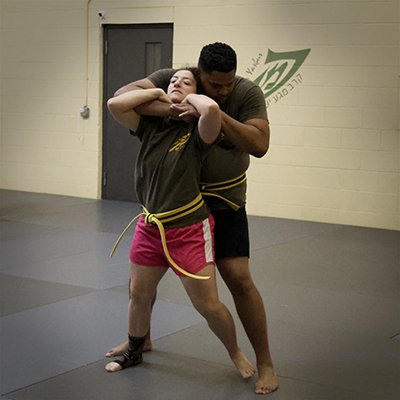 Whilst KAPAP was being shaped in Palestine, a young man in Europe, Imi Sde-Or (
Imi Lichtenfeld), was developing the skills that would later form the foundation of
Krav Maga.
Born in 1910 in Budapest and raised in Bratislava, Imi trained in boxing, wrestling, and gymnastics. During the 1930s, as fascist violence spread across Central Europe, he
organized groups of Jewish boxers and wrestlers to defend their communities against anti-Semitic gangs. In these street fights, he discovered that the rules and traditions of
combat sports were ill-suited to real violence. Effective survival depended on efficiency, adaptability, and aggression.
Whilst KAPAP was being shaped in Palestine, a young man in Europe, Imi Sde-Or (
Imi Lichtenfeld), was developing the skills that would later form the foundation of
Krav Maga.
Born in 1910 in Budapest and raised in Bratislava, Imi trained in boxing, wrestling, and gymnastics. During the 1930s, as fascist violence spread across Central Europe, he
organized groups of Jewish boxers and wrestlers to defend their communities against anti-Semitic gangs. In these street fights, he discovered that the rules and traditions of
combat sports were ill-suited to real violence. Effective survival depended on efficiency, adaptability, and aggression.
When Imi immigrated to Palestine in 1942, he brought this hard-earned experience with him. After serving with Jewish units under the British Army and then with the Haganah, Imi became a key instructor for the newly established Israel Defense Forces (IDF) in 1948. Here, his approach to close combat became formalized as Krav Maga—literally “contact combat.” Unlike KAPAP, which was eclectic and training-oriented, Krav Maga was codified as a system that could be taught in stages, scaled to civilian, law enforcement, and military applications.
The Role of Hisardut
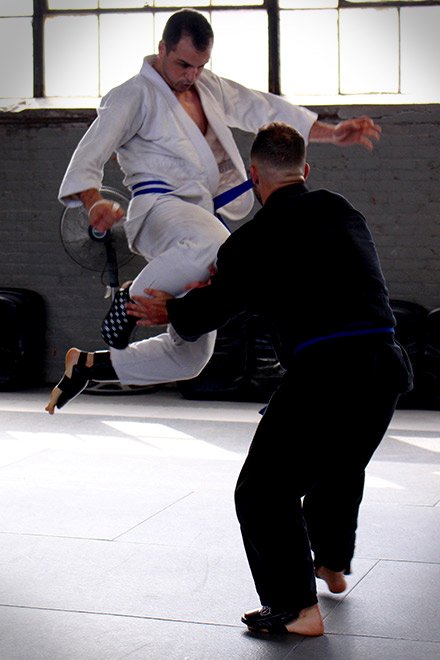 Whilst Krav Maga and KAPAP became closely tied to the military, another discipline, Hisardut, was developed by a South African Jew who had made Aliyah (עֲלִיָּה), which literally means
“ascent” in Hebrew, coming to live in Israel. Hisardut, meaning “survival” in Hebrew, was originally a survival-oriented martial system created by Imi’s contemporary Dennis Hanover.
Hanover, influenced by karate, judo, and other Asian systems, developed Hisardut in the 1960s as a hybrid martial art emphasizing both combatives and general survival skills.
Whilst Krav Maga and KAPAP became closely tied to the military, another discipline, Hisardut, was developed by a South African Jew who had made Aliyah (עֲלִיָּה), which literally means
“ascent” in Hebrew, coming to live in Israel. Hisardut, meaning “survival” in Hebrew, was originally a survival-oriented martial system created by Imi’s contemporary Dennis Hanover.
Hanover, influenced by karate, judo, and other Asian systems, developed Hisardut in the 1960s as a hybrid martial art emphasizing both combatives and general survival skills.
Hisardut incorporated striking, grappling, and weapon training but framed them within a philosophy of endurance, adaptation, and resilience. Where Krav Maga was often stripped down for battlefield utility, Hisardut allowed for deeper exploration of martial techniques, combining Israeli pragmatism with international martial influences. It became popular in certain civilian contexts, particularly for long-term training rather than immediate military application. Krav Maga Yashir Head Instructor, Gershon Ben Keren, is a 3rd Degree Black Belt in Hisardut, otherwise known as DSJJ (Dennis Survival Ju-Jitsu).
Interconnections and Divergences
The three systems—KAPAP, Krav Maga, and Hisardut—share a lineage yet diverge in emphasis:
- KAPAP was primarily a pre-state militia training regimen, a toolbox of combative skills that emphasized whatever was practical at the time. After the formation of Israel and the institutionalization of the IDF, KAPAP declined in prominence but saw revival in the 1990s as a historical and modernized system.
- Krav Maga, systematized by Imi, became the most enduring martial export of Israel, both inside the IDF and internationally, due to its streamlined pedagogy and scalability to civilians.
- Hisardut developed as a longer-term martial system emphasizing survival skills, resilience, and integration of foreign martial arts, which made it distinct from Krav Maga’s purely utilitarian roots. Many of the IDF’s top Krav Maga instructors are in fact students of Dennis Hanover, and Hisardut is used by many of the IDF’s elite units – though referred to within the military as “Krav Maga”.
Together, these systems demonstrate how Israeli martial arts were forged under unique historical pressures: survival in a hostile environment, the demands of military conscription, and the need for both rapid instruction and enduring cultural identity.
International Expansion of Krav Maga
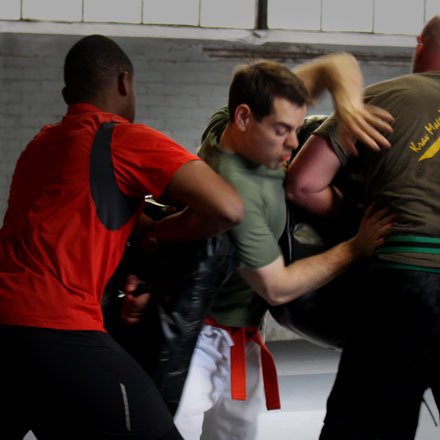 While KAPAP and Hisardut remained largely within Israeli contexts, Krav Maga spread globally from the 1970s onwards. After retiring from the IDF in 1964, Imi Lichtenfeld
dedicated himself to teaching Krav Maga to civilians, refining techniques for law enforcement and ordinary self-defense.
While KAPAP and Hisardut remained largely within Israeli contexts, Krav Maga spread globally from the 1970s onwards. After retiring from the IDF in 1964, Imi Lichtenfeld
dedicated himself to teaching Krav Maga to civilians, refining techniques for law enforcement and ordinary self-defense.
His students, such as Eli Avikzar, Miki Assulin, Eyal Yanilove and others, carried Krav Maga into civilian schools, law enforcement academies, and eventually the international stage. By the 1980s and 1990s, Krav Maga organizations had formed in Europe, North America, and South America, with instructors teaching both civilians and police/military units. Its reputation as a brutally effective, reality-based martial art attracted practitioners worldwide, especially as terrorism and urban violence became global concerns.
Israeli Martial Arts Today
In contemporary Israel, Krav Maga, KAPAP, and Hisardut coexist as part of a broader martial ecosystem. Krav Maga remains the central system taught to IDF soldiers and is the most internationally recognized. KAPAP has undergone a revival, marketed both as a historical tradition and as a modern combatives approach. Hisardut continues in smaller circles, carrying Dennis Hanover’s vision of survival-focused martial arts.
The unifying feature across these systems is their pragmatic foundation: Israeli martial arts were never designed for sport or spectacle but for survival in a reality of constant threat. This focus on adaptability, efficiency, and psychological resilience differentiates them from many traditional martial arts rooted in ritual or competition.
The history of Krav Maga cannot be fully understood without reference to KAPAP and Hisardut, the sister systems that reflect different facets of Israeli martial development. KAPAP was the first pragmatic training framework, developed under the pressures of pre-state violence. Krav Maga, forged by Imi Lichtenfeld’s unique experiences and institutionalized within the IDF, became the defining Israeli martial art, streamlined for soldiers and later adapted for civilians worldwide. Hisardut offered a broader survival philosophy, blending martial training with resilience and long-term adaptability.
Together, these three systems embody the essence of Israeli martial arts: practical, adaptive, and inseparable from the history of a people who faced existential threats and required combative methods that could be learned quickly and applied under the harshest realities. Today, while Krav Maga dominates the global stage, the legacies of KAPAP and Hisardut remain integral to the story of how Israeli martial arts were born, evolved, and continue to influence the world.